When Did Zachariah Start to Speak Again
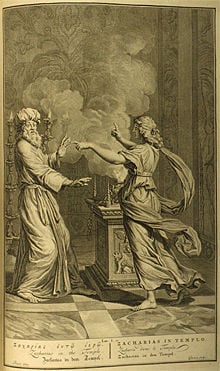
Zechariah (Zacharias in the Male monarch James Version of the Bible) was the father of John the Baptist. He was a Jewish priest of the line of Abijah during the reign of King Herod the Not bad at the turn of the common era. He was married man of Elizabeth, who was also of a priestly lineage. Their son, John the Baptist, became a famous preacher, identified in the New Testament as a prophet and primary precursor of Jesus as the Messiah.
Co-ordinate to Luke's gospel, Zechariah received a revelation from the angel Gabriel while ministering in the Temple of Jerusalem, telling him that Elizabeth, though well beyond the age of child-bearing, would bear him a son. He was struck dumb for non initially assertive this prophecy. Elizabeth did conceive, and during her pregnancy, she and Zechariah offered hospitality to Elizabeth's cousin Mary. After iii months in Zechariah's domicile, the visibly meaning Mary returned to Nazareth. Later the birth of John the Baptist, Zechariah was able to speak again, and he prophesied that John would "keep before the Lord to prepare the manner for him."
The biblical traditions about Zechariah are centered on the nativity of John the Baptist; he plays no function in the Jesus story despite Mary'due south visit to their home. Hence, for most Christians he is a minor effigy. A unique view is found in the teachings of the Unification Church building, by which Zechariah was Jesus' begetter.
Contents
- ane Zechariah'due south story
- 1.one Run into with Gabriel
- 1.2 With Elizabeth and Mary
- 1.3 The Birth of John
- 1.iv Zechariah's expiry
- 2 Zechariah co-ordinate to esoteric Unification interpretations
- 3 Legacy
- 4 References
- five Credits
Zechariah'south death is not recorded in the New Testament, although an apocryphal tradition in the Infancy Gospel of James reports that he was murdered by agents of Herod the Groovy in the temple courtyard.
Zechariah's story
Zechariah is identified in Luke's gospel equally belonging to the segmentation of Abijah, one of the priestly families assigned to temple ministry building in 1 Chronicles 23-24. The evangelist states that both Zechariah and Elizabeth were righteous before God, strictly observing all of the traditional commandments and ordinances. Like several important couples in the Hebrew Bible, however, their spousal relationship was childless. Elizabeth was arid and, like her married man, was advanced in years (Luke 1:v-7).
Encounter with Gabriel
Luke relates that during his clan's turn to serve in Jerusalem, Zechariah was chosen past lot "to get into the temple of the Lord and burn incense" (Luke one:9). Priestly duties at the Temple in Jerusalem alternated between each of the families that had descended from those appointed by King David to minister at that place (i Chronicles 23:1-19). While priests were routinely immune in the inner courtyard of the temple, to enter the building was a rare privilege. The offer of incense was one of the nigh solemn parts of the daily worship. Some experts believe that, owing to the large number of eligible priests, no priest could hope to perform the chore more than than once during his lifetime.
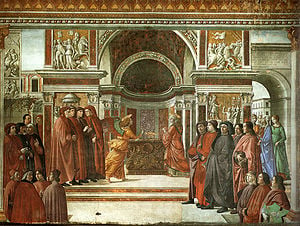
Gabriel appears to Zechariah.
While Zechariah ministered at the golden altar of incense, an angel of God announced to him that his wife would give birth to a son, whom he was to name John, who would exist a strict Nazirite from birth and would fulfill the mission of the prophet Elijah every bit the forerunner of the long-expected Messiah.
He will be a joy and delight to you, and many will rejoice because of his nascence, for he will be corking in the sight of the Lord. He is never to accept wine or other fermented beverage, and he will exist filled with the Holy Spirit fifty-fifty from birth. Many of the people of State of israel will he bring back to the Lord their God. And he will keep before the Lord, in the spirit and ability of Elijah, to turn the hearts of the fathers to their children and the ill-behaved to the wisdom of the righteous—to brand ready a people prepared for the Lord (Luke 1:14-17).
Citing their avant-garde age, Zechariah asked for a sign whereby he would know the truth of this prophecy. The angel identified himself every bit the Archangel Gabriel, sent especially past God to make this announcement. He declared that because of Zechariah's doubt, he would be struck dumb and "not able to speak until the day that these things happen." Consequently, when Zechariah went out to the waiting worshipers, he was unable to pronounce the customary blessing (Luke one:eighteen-22).
With Elizabeth and Mary
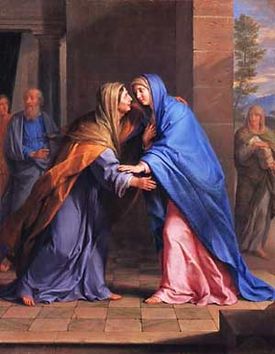
Zechariah'due south wife Elizabeth welcomes Mary.
Zechariah returned abode to the hill country of Judea, and Elizabeth indeed conceived a son. For 5 months she remained in seclusion, while Zechariah himself continued to be speechless. In the sixth month, Zechariah and Elizabeth received an unexpected visit from Mary, Elizabeth'southward cousin. The immature woman, who was betrothed to Joseph of Nazareth, remained in Zechariah's home for three months. She and so returned, pregnant, to her unsuspecting betrothed husband in Nazareth.
The Magnificat, or "Song of Mary" preserved by Luke indicates her initial joy at her pregnancy:
From now on all generations will call me blest,
for the Mighty One has done great things for me
Holy is his name…
He has scattered those who are proud in their inmost thoughts.
He has brought down rulers from their thrones only has lifted upwardly the humble.
He has filled the hungry with good things simply has sent the rich away empty.
He has helped his servant Israel
remembering to be merciful to Abraham and his descendants forever,
even equally he said to our fathers (Luke 1:49-53).
Footling is said about the relations among the iii residents of Zechariah's house during this period.
The Birth of John
Soon, Zechariah's son was born and eight days later on the family unit gathered for the traditional circumcision anniversary. Elizabeth declared that his proper name was to be John, simply the family objected to this on the grounds that this proper noun had not been used by any of his ancestors. Zechariah, all the same, confirmed the proper noun by writing on a tablet: "His name is John." Miraculously, he immediately regained the ability of voice communication. Luke preserves Zechariah's ensuing prophecy:
Praise be to the Lord, the God of Israel,
because he has come and has redeemed his people.
He has raised up a horn of salvation for u.s.
in the house of his servant David…
conservancy from our enemies
and from the hand of all who hate us…
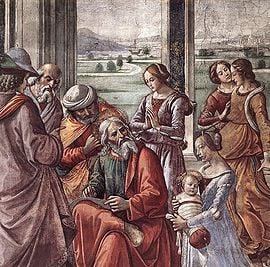
Zechariah confirms, "His name is John."
Some scholars believe this section of Zechariah's prophecy indicates that John the Baptist himself was its discipline since Jesus had not yet been born. According to this theory, the Christian movement appropriated traditions about John and subordinated them to Jesus. Information technology is known historically that John the Baptist had a broad following, who continued to honor him even after his death. In any case, the final prophecy of Zechariah makes information technology clear that John is not the Messiah himself, but his precursor:
And y'all, my child, volition be called a prophet of the Most High;
for you volition go on before the Lord to prepare the way for him,
to give his people the knowledge of conservancy
through the forgiveness of their sins,
because of the tender mercy of our God (Luke 1:sixty-79).
The kid grew upwardly and "became strong in spirit," but nothing more is said of Zechariah.
Zechariah'south expiry
A expert deal of confusion exists about the death of Zechariah. In fact, it is not recorded in the Bible, but a passage referring to another Zechariah has been interpreted every bit referring to John's father. The Gospel of Matthew quotes Jesus equally referring to "Zechariah son of Berekiah," as having been "murdered between the (wall of the) temple and the (courtyard) altar" (Matthew 23:35). The second century apocryphal Infancy Gospel of James apparently identifies this man with Zechariah the male parent of John, elaborating on the reference by relating a story of Zechariah'due south death at the easily of agents of Herod the Great, who feared that John, a possible Messiah, might threaten his throne:
Now Herod sought for John… And Herod was wroth and said: "His son is to be king over Israel." …Zacharias [after refusing to divulge John's whereabouts] said: "I am a martyr of God if thou sheddest my blood: For my spirit the Lord shall receive, because k sheddest innocent blood in the fore-court of the temple of the Lord." And about the dawning of the mean solar day Zacharias was slain.
Nonetheless, this tradition appears to exist based on a misunderstanding of Jesus' reference in Matthew. "Zechariah son of Berekiah" is not John's father, simply is identified in the Old Attestation as none other than the author of the Volume of Zechariah who lived during the fifth century B.C.E. (Zech. ane).
To brand matters more confusing, Matthew (or possibly Jesus himself) seems confused well-nigh the facts of the instance of the prophet who was killed in the temple courtyard. According to the Book of Chronicles, it was not Zechariah son of Berekiah that was killed there, but "Zechariah son of Jehoiada the priest" (2 Chronicles 24:20), who was "stoned to death in the courtyard of the Lord's temple" for opposing the king'south tolerance of Asherah poles and idol worship.
Zechariah according to esoteric Unification interpretations
Co-ordinate to lesser known teachings of the Unification Church building, which does not accept the virgin birth, Zechariah could have been the biological father of Jesus. The angel Gabriel directed Mary to Zechariah's house, and conveyed to her God's instructions regarding relations with Zechariah that would result in the nascence of Christ, God's only begotten son. Zechariah, Elizabeth, and Mary later should have protected Jesus, who could take grown up as a child of privilege in their priestly home. However, because circumstances forced Mary from Zechariah's house when she was three months pregnant, for an uncertain future with Joseph, Jesus was exposed to allegations that he was illegitimate. Their estrangement also created distance between Jesus and Elizabeth's son John the Baptist, which later would predispose John to doubt Jesus' ministry (Matt. 11:four-eleven).
Legacy
Zechariah is honored as a prophet and a saint in Roman Catholic, Eastern Orthodox, Lutheran, and other Christian traditions. Islam too accepts him as one of the prophets. Unification Tradition honors Zechariah'due south righteousness and initial organized religion, simply affirms that he failed to fulfill his mission completely, to protect Jesus, and to foster unity betwixt Jesus and John the Baptist.
References
ISBN links support NWE through referral fees
- Edwards, Everett. John the Baptist In-Depth, a Closer Await. Pleasant Word, 2006. ISBN 978-1414106977
- Tatum, Due west. Barnes. John the Baptist and Jesus: A Written report of the Jesus Seminar. Polebridge, 1994. ISBN 978-0944344422
- Wink, Walter. John the Baptist in the Gospel Tradition. Cambridge University, 2006. ISBN 978-0521031301
Credits
New World Encyclopedia writers and editors rewrote and completed the Wikipedia commodity in accord with New Earth Encyclopedia standards. This article abides past terms of the Creative Commons CC-by-sa three.0 License (CC-by-sa), which may exist used and disseminated with proper attribution. Credit is due under the terms of this license that can reference both the New Globe Encyclopedia contributors and the selfless volunteer contributors of the Wikimedia Foundation. To cite this article click hither for a list of acceptable citing formats.The history of earlier contributions by wikipedians is accessible to researchers hither:
- Zechariah history
The history of this article since it was imported to New World Encyclopedia:
- History of "Zechariah"
Note: Some restrictions may apply to utilise of individual images which are separately licensed.
Source: https://www.newworldencyclopedia.org/entry/Zechariah
0 Response to "When Did Zachariah Start to Speak Again"
Post a Comment